
Agentic AI Ontology • For EVM analysts with Empower

Agentic AI Ontology for EVM.

The bounded world model and command surface behind every KUON EVM analyst. Not a diagram of the domain — a typed, replayable, reversible runtime that turns intent into evidence-led action against Empower, the source of record. The EVM Ontology Viewer is what the principle looks like when an analyst can drive it.

Where the ontology meets the analyst's screen.

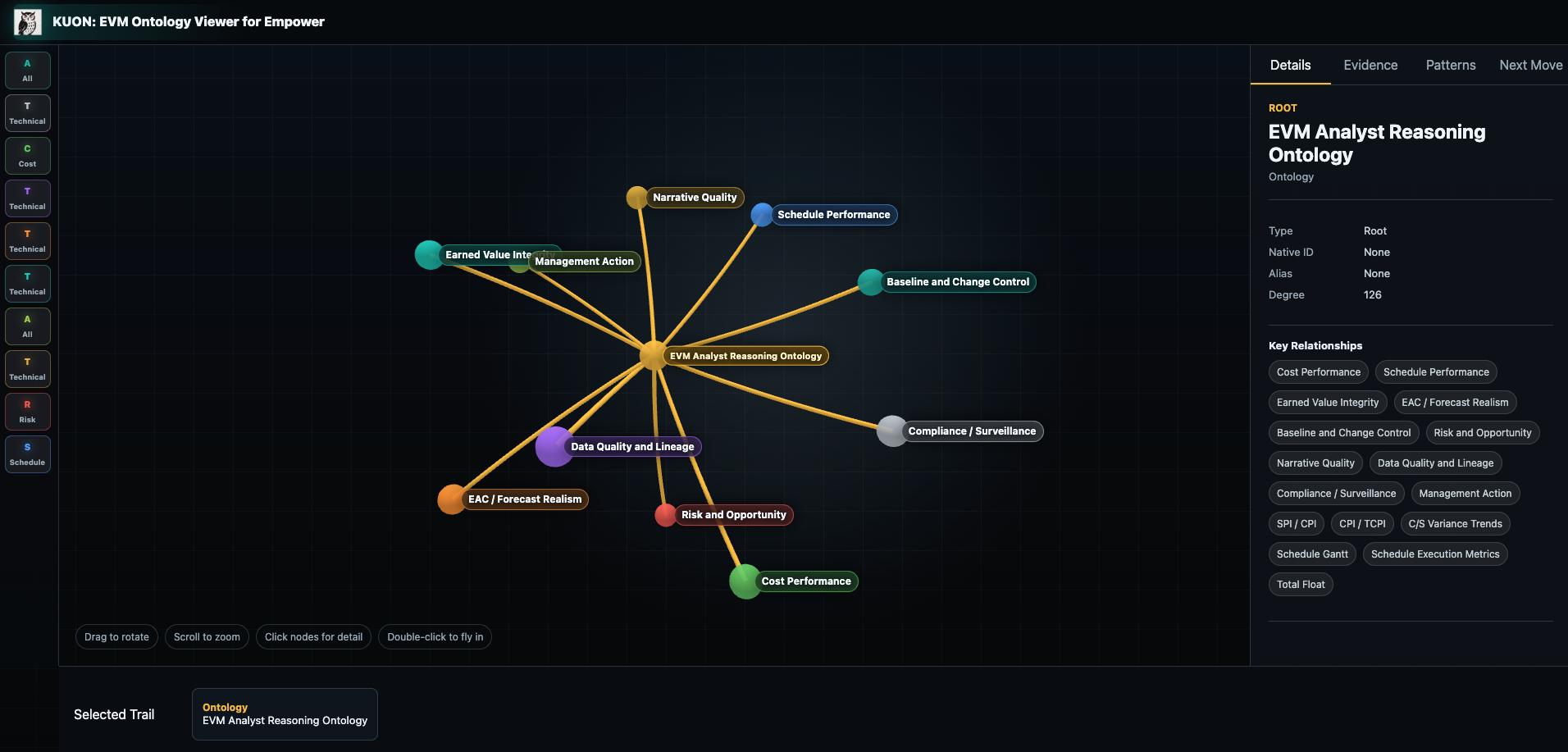
The EVM Ontology Viewer is the visual surface of the Agentic Ontology. Same typed commands, same evidence chain, same rollback verbs — rendered as a navigable world model the analyst can drive. Below: the opening session, with every region named in the analyst's vocabulary.

KUON EVM Ontology Viewer for Empower — opening session. Top header reads KUON: EVM Ontology Viewer for Empower. Left rail with domain-normalized glyphs (A All, T Technical, C Cost, T Technical, T Technical, T Technical, A All, T Technical, R Risk, S Schedule). Center 3D graph on a dark background with the EVM Analyst Reasoning Ontology at root connected to 10 primary branches: Narrative Quality, Schedule Performance, Earned Value Integrity, Management Action, Baseline and Change Control, Data Quality and Lineage, Compliance / Surveillance, EAC / Forecast Realism, Risk and Opportunity, Cost Performance. Bottom control hints: Drag to rotate, Scroll to zoom, Click nodes for detail, Double-click to fly in. Right panel with Details tab active, ROOT label, EVM Analyst Reasoning Ontology title, Type Root, Native ID None, Alias None, Degree 126, and 16 key relationship chips (Cost Performance, Schedule Performance, Earned Value Integrity, EAC / Forecast Realism, Baseline and Change Control, Risk and Opportunity, Narrative Quality, Data Quality and Lineage, Compliance / Surveillance, Management Action, SPI / CPI, CPI / TCPI, C/S Variance Trends, Schedule Gantt, Schedule Execution Metrics, Total Float). Selected Trail at the bottom reads Ontology → EVM Analyst Reasoning Ontology.
Root view: EVM Analyst Reasoning Ontology (degree 126). All 10 primary branches visible at the root. The right panel surfaces 16 key relationships — every chip is a typed, actionable control wired into Empower.
  1. 01
    The home node. KUON: EVM Ontology Viewer for Empower. Sticky, compact, persistent — never blocks the world model. The owl mark is the only navigation that violates the path-following model; it returns the analyst to the ontology root, every time, without exception. The home button is the rollback for the entire session.
  2. 02
    Direct paths from the selected node. Domain glyphs normalized to A · T · C · R · S — All / Technical / Cost / Risk / Schedule. Each glyph is color-tracked to the branch family it connects to. The rail is a typed query: it shows only the named paths directly reachable from the currently selected node, not the whole ontology as a checklist.
  3. 03
    The ontology, rendered as a graph. EVM Analyst Reasoning Ontology at center. All 10 primary branches — Narrative Quality · Schedule Performance · Earned Value Integrity · Management Action · Baseline and Change Control · Data Quality and Lineage · Compliance / Surveillance · EAC / Forecast Realism · Risk and Opportunity · Cost Performance — rendered as typed, color-coded nodes connected by primary-branch edges. The graph owns the screen because the world model is the subject, and depth matters when leaves must not crowd the root.
  4. 04
    Navigate the world model in 3D. Drag to rotate · Scroll to zoom · Click nodes for detail · Double-click to fly in. The 3D depth is not decoration — it is how leaves separate visually without crowding. After a short idle period, the camera orbits the selected node so depth becomes legible without manual dragging, and the typed relationships stay readable.
  5. 05
    The action surface, not decorative chrome. ROOT · EVM Analyst Reasoning Ontology · Type Root · Degree 126 · 16 key relationship chips. Every chip on every tab is a typed, actionable control. Click one and the viewer builds the exact Empower CLI command and posts it to the local bridge — Empower is the source of record, and the ontology never invents the number.
  6. 06
    One context, three regions, no drift. Ontology → EVM Analyst Reasoning Ontology. The rail, the graph, and the detail panel are not three views of the same thing — they are three projections of one typed selection. Continuity of thought, not reconciliation. The CAM and the reviewer walk the same path, and the audit log records who clicked what, when, and against which Empower artifact.

The principle behind the surface.

The Agentic Ontology is not documentation. It is not a graph database behind a query language. It is an operational runtime — bounded, typed, auditable, reversible — and for EVM analysts using Empower, that means every variance claim, every evidence citation, and every narrative draft traces back to a named command against Empower. Not an interpretation. Not an inference. A typed action whose trail any reviewer can walk.

Bounded

A finite world the analyst can name.

A declared, typed set of objects — branches, evidence classes, reasoning patterns, artifacts. Nothing implicit. Nothing hidden. If the ontology cannot name it, the analyst cannot claim it, and the reviewer will not be asked to accept it.

Typed

A grammar the ontology can refuse.

Every relationship has a type. Every command has a schema. The ontology refuses to skip a step — and that refusal is the point. It is what makes the question "where did this number come from?" answerable in one chip click.

Auditable

Every action leaves a trail.

Every selection, every chip click, every CLI call is logged with its actor, intent, command, and result. The CAM and the reviewer walk the same path. No silent moves. No invisible state. The audit is not a separate document — it is the world model in motion.

Reversible

One verb from rollback.

Every state change carries a one-verb rollback. Nothing the analyst does in the viewer is irreversible. The ontology stays honest because undo is always one command away, and the audit log shows when undo was needed and what it restored.

What this changes for the EVM analyst.

The principle is small; the daily-life consequences for the CAM, the analyst, and the reviewer are large. Four workflows collapse into one continuous, evidence-led surface — and the world model never drifts from Empower.

Variance review

The narrative is written against the chain, not after it.

Every claim in the CAM's draft is a typed relationship to a named Empower artifact. Reviewers stop asking "where did this number come from?" — the chip shows them, the trail logs when, and the variance explanation owns its evidence from the first sentence to the last.

Evidence chain

The chain is the audit, and the audit is one click away.

Each branch, pattern, and conclusion carries its evidence class forward. When the analyst clicks a chip on the right panel, the ontology walks the chain — Empower export → artifact → narrative claim. The chain is the audit, and the audit is always one click away from the analyst, the reviewer, and the contract lead.

Review prep

Hard questions become typed paths through the world model.

"What are the cost drivers off-plan?" is a single rail selection. "What evidence backs this narrative?" is one chip click. "What pattern applies to this corrective action?" is one tab. The hardest review questions become a path through the world model, not a search through exports.

Narrative drafts

Drafts and audit trail are written together, not reconciled after.

When a chip posts an Empower CLI command, the response is logged with the source ontology node. The CAM owns the explanation, and the explanation owns its trail. The narrative draft and the audit are the same document — not two documents that have to be reconciled under review pressure.

Where the ontology speaks Empower's language.

Empower is the source of record. The Agentic Ontology never invents a number. When the analyst clicks a chip in the right panel, the viewer builds the exact Empower CLI command the analyst would type — empower artifact open --artifact-id "BCWR by CAM" — then routes it through the local Empower CLI bridge running in the analyst's environment. If the bridge isn't reachable, the viewer says so and copies the command to the clipboard. Never a fake success. Never a phantom result. The audit trail is honest because the failure mode is honest.

empower artifact open --artifact-id "BCWR by CAM"

POST  {empower-cli-bridge}/empower-cli   // local bridge in the analyst's environment
Content-Type: application/json

{
  "command": "empower artifact open --artifact-id \"BCWR by CAM\"",
  "action":  "open-artifact",
  "artifact": {
    "id":     "bcwr-by-cam",
    "label":  "BCWR by CAM",
    "nativeId": "empower:...",
    "alias":  "bcwr-by-cam",
    "family": "chart",
    "branches":  [],
    "patterns":  [],
    "evidenceClasses": []
  },
  "context": {
    "id":    "selected-node-id",
    "label": "selected-node-label"
  }
}

Bring the bounded world model to your EVM program.

The ontology is live. The principle is committed. Talk to KUON about how the Agentic Ontology can land inside your EVM review cycle — for the CAM, the analyst, and the reviewer, with Empower as the source of record.

Open the EVM Ontology Viewer →