Ideas made real in systems designed to endure change.
Shiori
Notebook · Multi-Platform
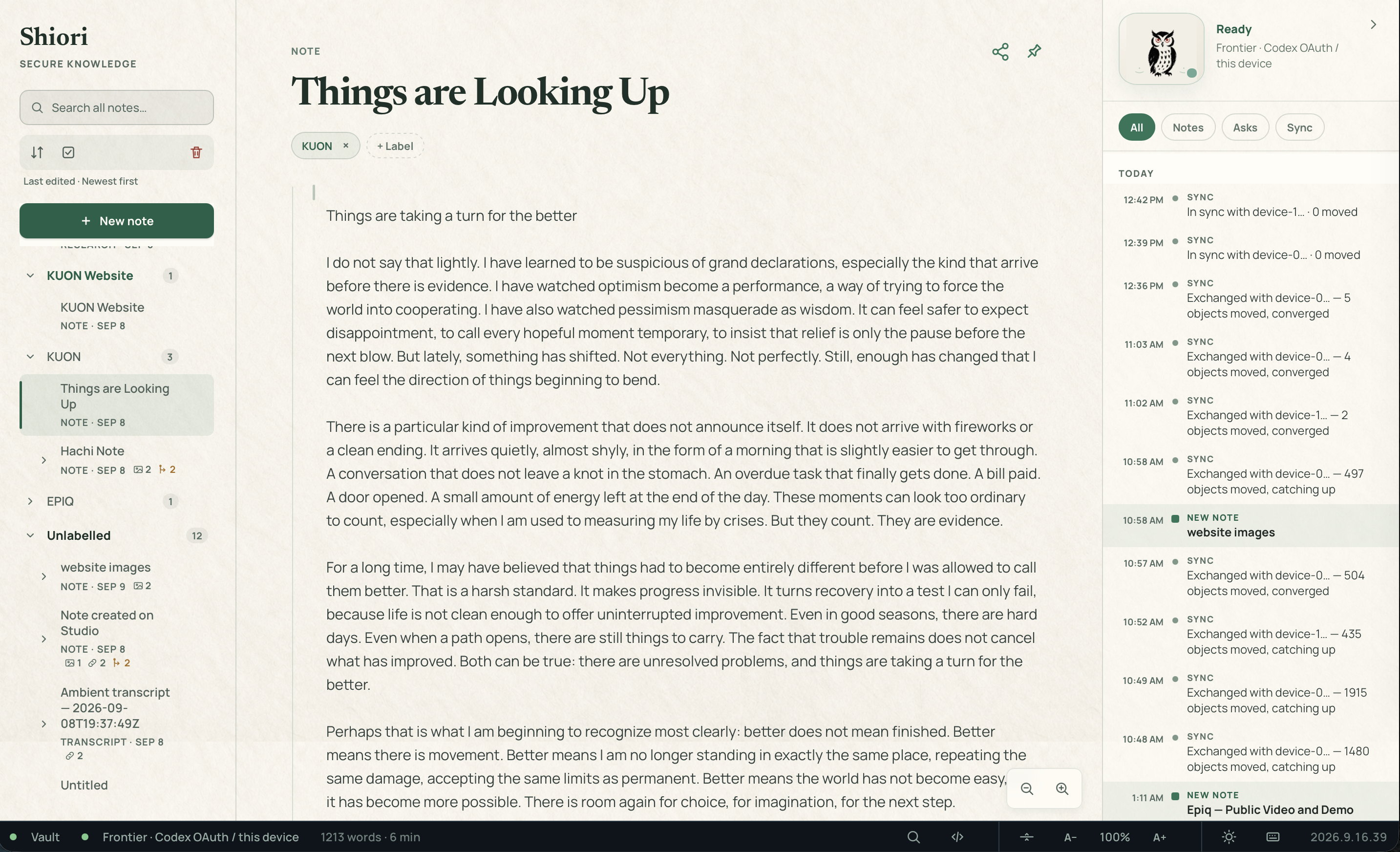
Shiori · Things are Looking Up · Open screenshot
Shiori is a notebook for capturing ideas and thinking them through. Start with a quick thought, a question, or a piece of research, and develop it at your own pace. Shiori brings AI into the place where an idea is being developed: the note itself. Writing, research, and conversation stay together, while the author decides what becomes part of the page. Ordinary Markdown keeps that work portable across all platforms.
Old meets new: the classic notebook, reimagined with agentic AI. Capture a thought, explore it with an AI agent, and shape what comes next—all within your private notes, anytime, wherever you work or think.
Ask AI to work with a note or selected passage.
Review proposed text and voice responses before including them in the page.
Carry notes between enrolled devices with encrypted sync and recovery packs.
Agentic CLI for AI Agent direct note access.
Native Tailscale architecture for secure peer-to-peer realtime data synchronization.
VAR Studio
Variance analysis · Encore Analytics Empower · In development
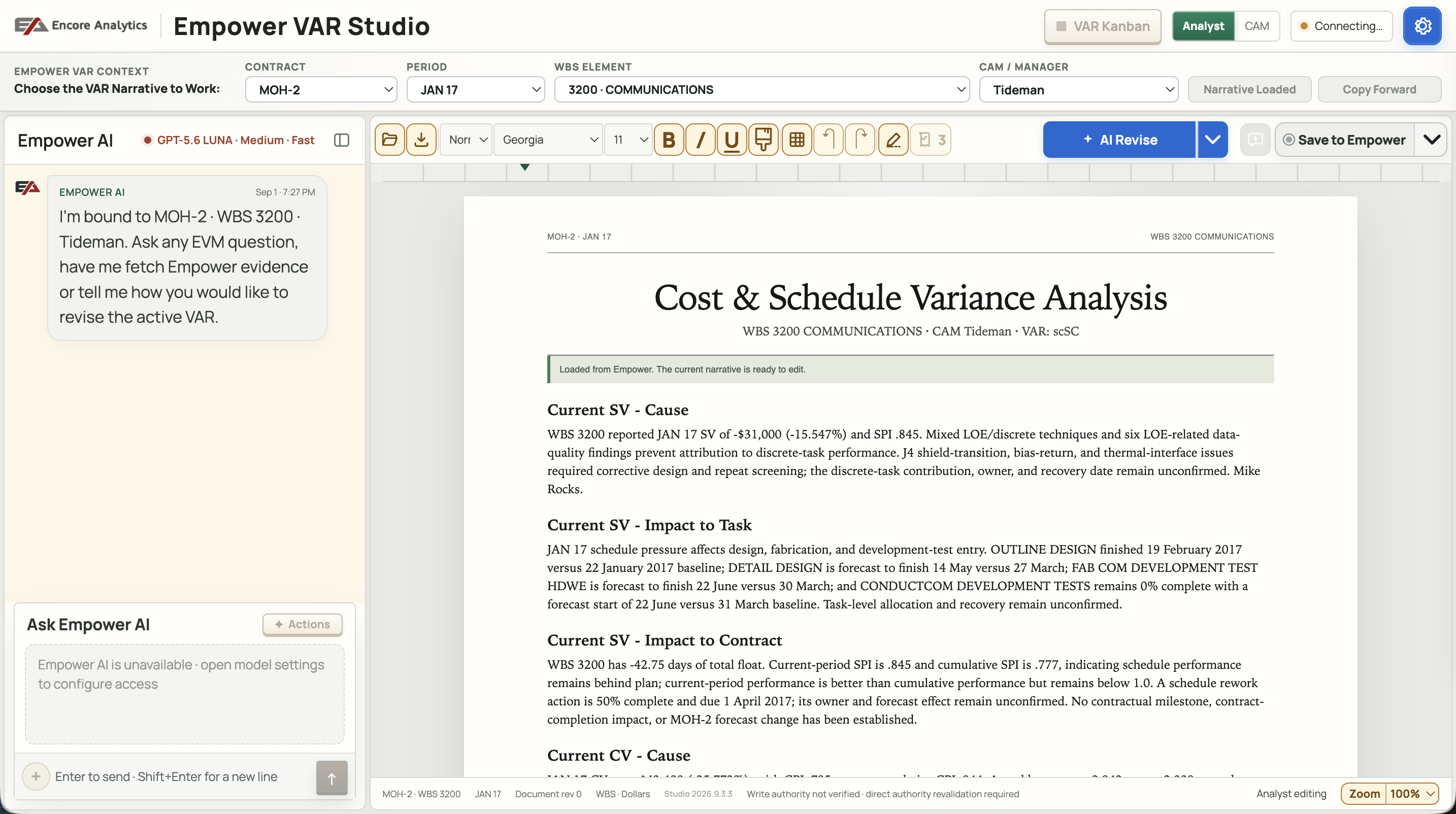
Empower demonstration data · Open screenshot
An AI-assisted workspace for drafting and reviewing variance analysis reports in Encore Analytics Empower. The narrative, supporting evidence, and proposed revisions come together in one place, so analysts can judge each change in context and keep their work connected to the official record.
Accept, reject, or undo proposed changes to individual report sections.
Inspect evidence for the selected contract, reporting period, and work breakdown element.
Use Empower CLI for native narrative and workflow operations under the user’s Empower permissions.
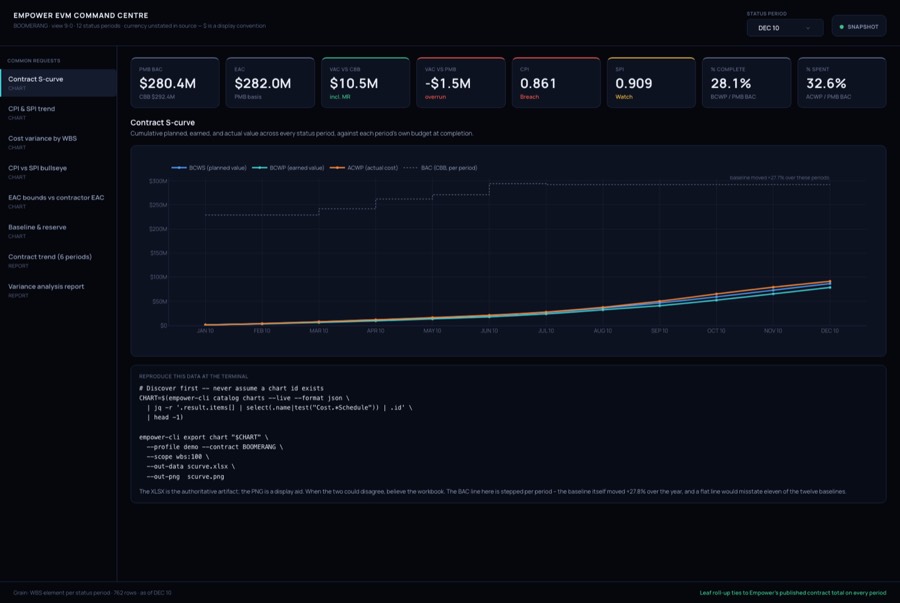
Valuable program information in Encore Analytics Empower should be usable beyond its screens. Empower CLI turns authorized access into repeatable commands, giving analysts and application builders a way to reuse reports and data while preserving the context needed to check their work.
Retrieve reports, charts, schedules, and other artifacts using your Empower account.
Keep the contract, reporting period, and origin with each output; check exported packages offline.
Discover available artifacts and permitted workflow actions from Empower itself.
CAM AI Training
Expert-led AI production · Humphreys & Associates
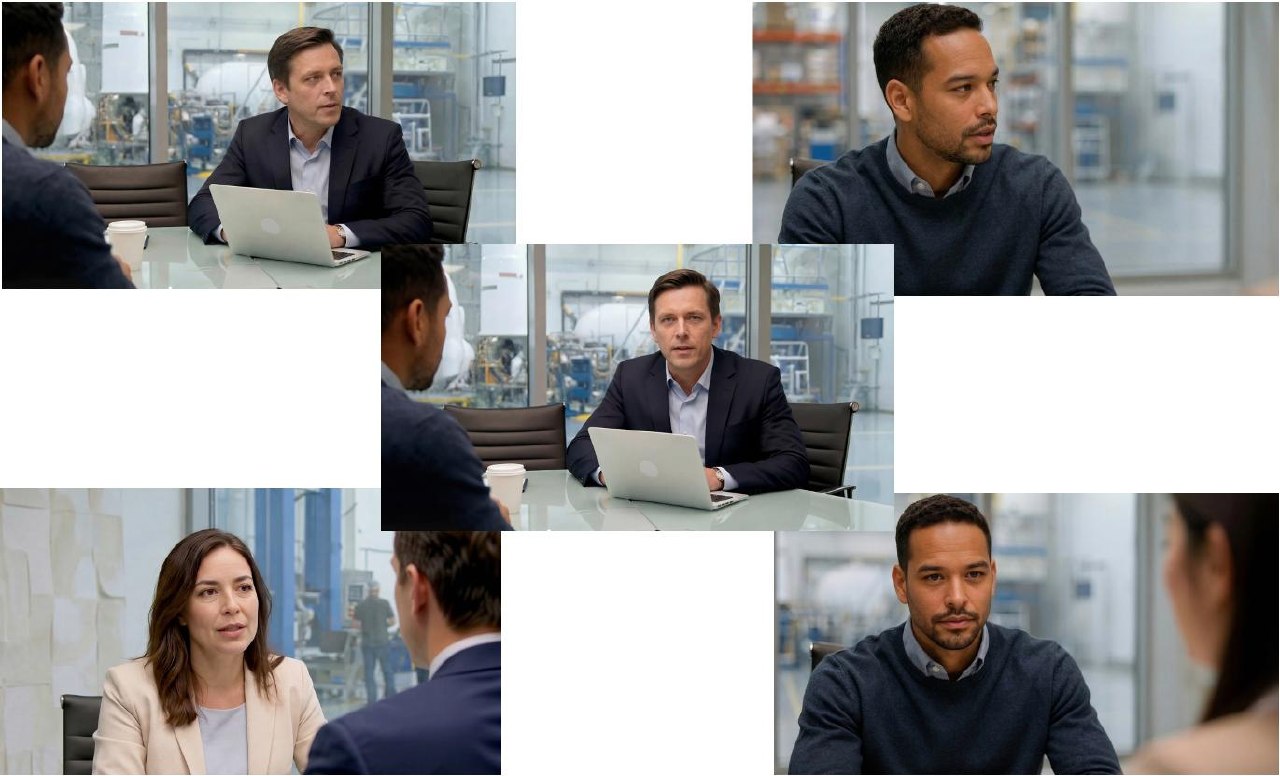
Specialist training needs to change without losing the expertise that makes it trustworthy. For Humphreys & Associates, KUON rebuilt CAM review preparation as a maintainable AI video course, keeping educators in control of the instruction. The result is a repeatable way to update training while preserving technical accuracy.
Migrated the original course and incorporated the H&A Education Team’s current practices and policy updates.
Refreshed EVM imagery with consistent terminology, pronunciation, casting, and scenes.
Delivered through professional video production and detailed educator review.
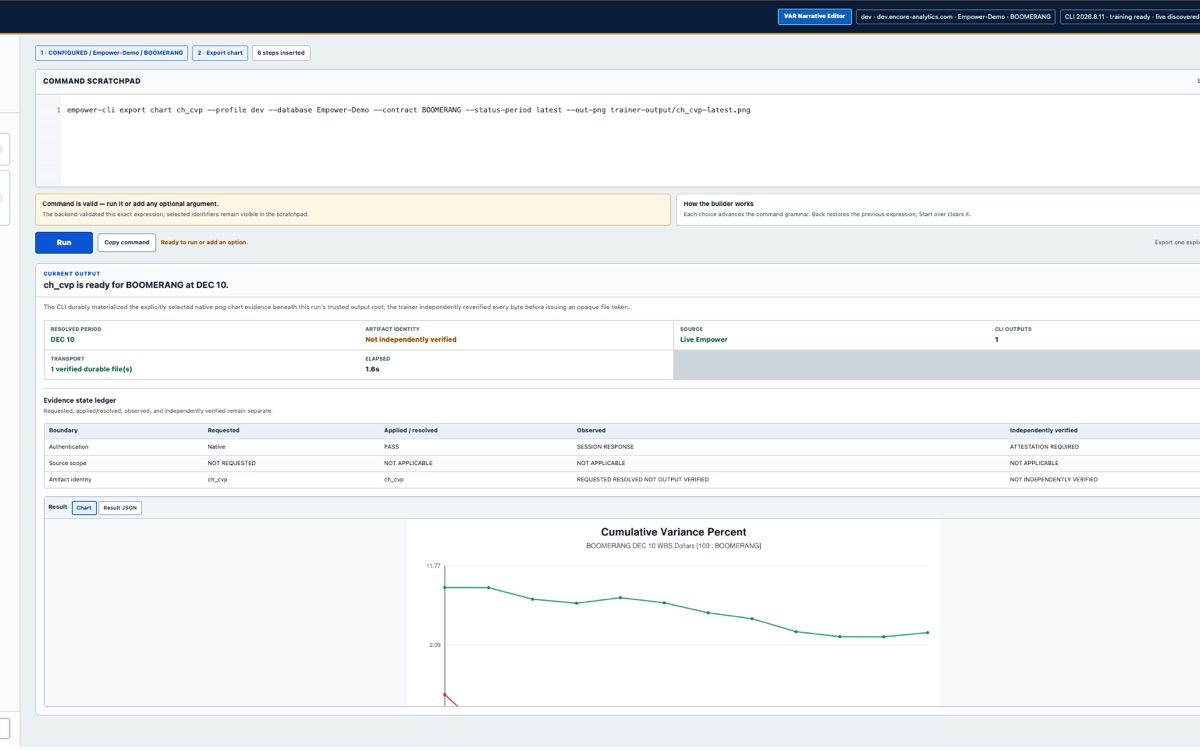
An integration should be built on observed behavior. Empower CLI Trainer makes Encore Analytics Empower commands visible and testable: choose a real reporting context, run the command, and inspect its actual result before making it part of an application.
Discover reports and charts from the connected server and inspect their returned outputs.
Exercise native Input functions using the workflow actions available to your account.
Read the record back after a commit so the saved result can be checked.
Agentic Data Warehousing
Data architecture · Power BI & Excel
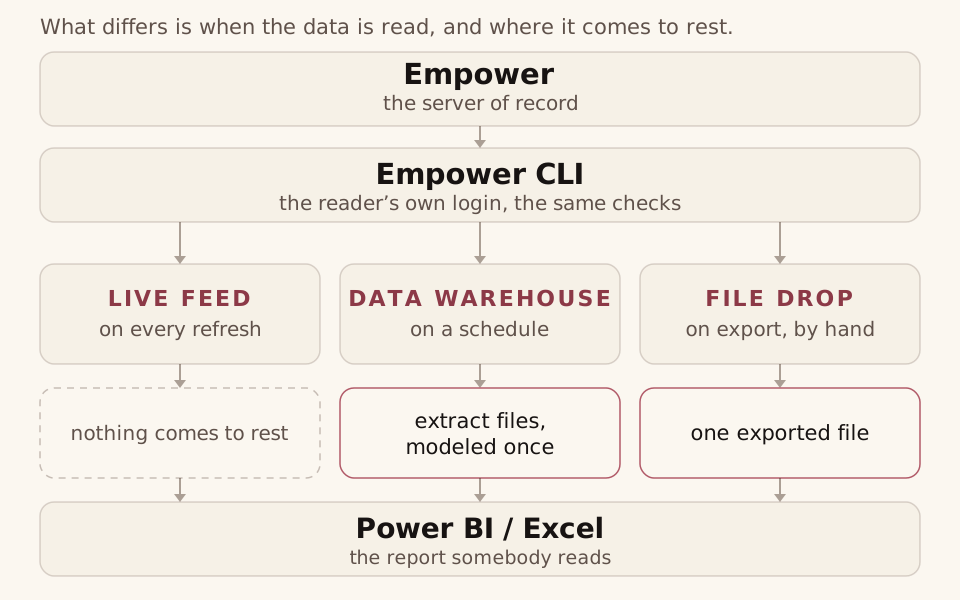
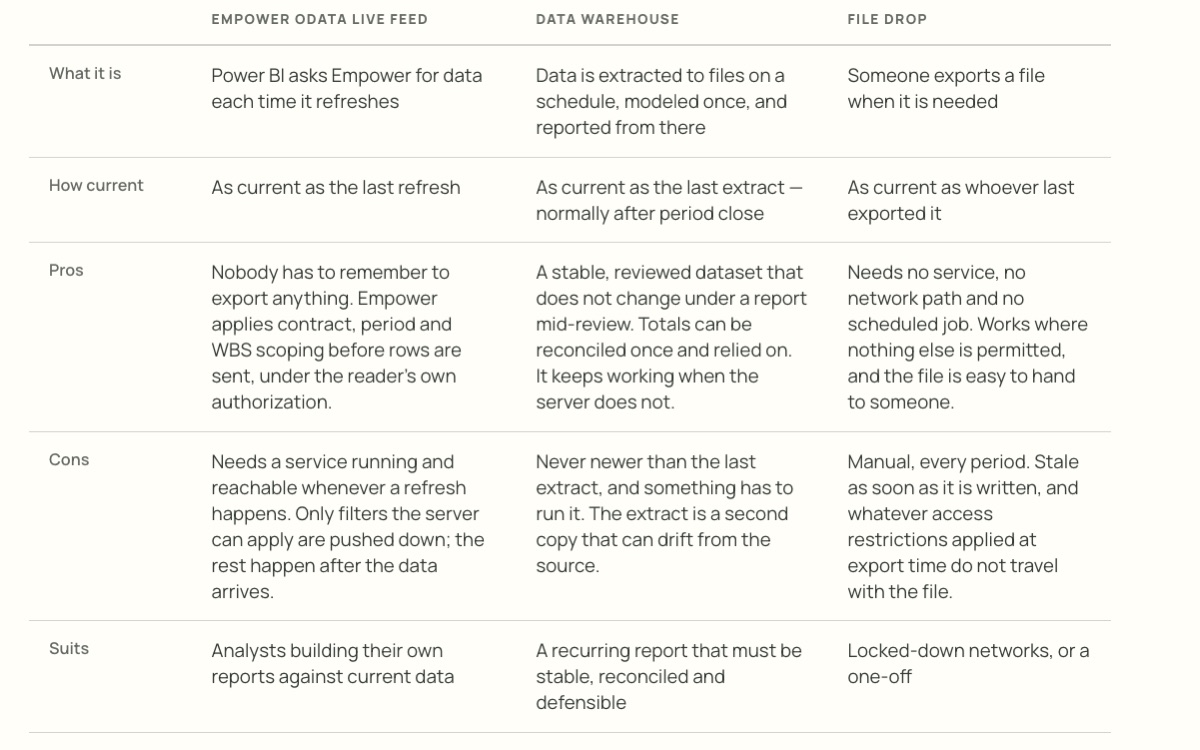
Choosing how program data reaches a report is an architecture decision, not a connector setting. KUON built the three supported routes out of Encore Analytics Empower on one foundation: the same read through Empower CLI, under the reader’s own login, with the same checks. What differs is when the data is read and where it comes to rest.
Serve Power BI and Excel from a live feed, with nothing left at rest between refreshes.
Schedule extracts into a dataset modeled once, when a report must stay stable through review.
Hand over a single exported file where no service or network path is permitted.
Empower OData
Trustworthy reporting · Power BI & Excel
A dashboard loses value when its numbers disagree with the system it reports on. Empower OData brings Encore Analytics Empower data into Power BI and Excel, with checks against Empower’s own exports and totals to catch discrepancies before they become reporting errors.
Compare published view data with Empower’s Excel export for the same view and period.
Stop a refresh when detailed values disagree with the contract total.
Recalculate cost and schedule indices from their underlying values as filters change.
RapidClaw
Conversational analysis · Encore Analytics Empower
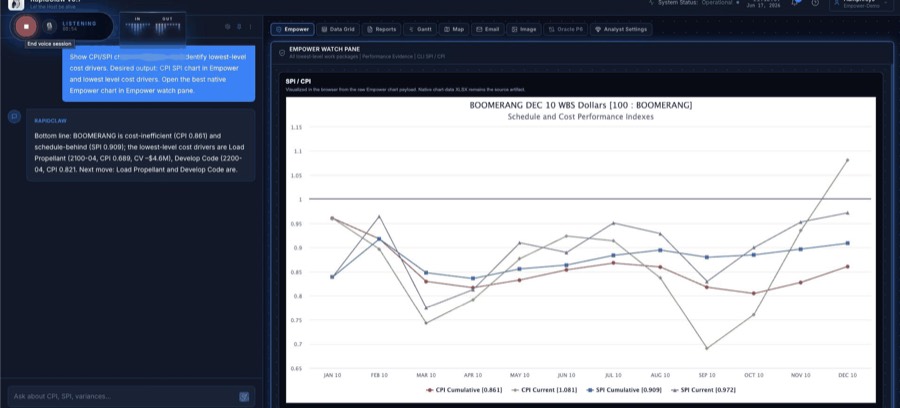
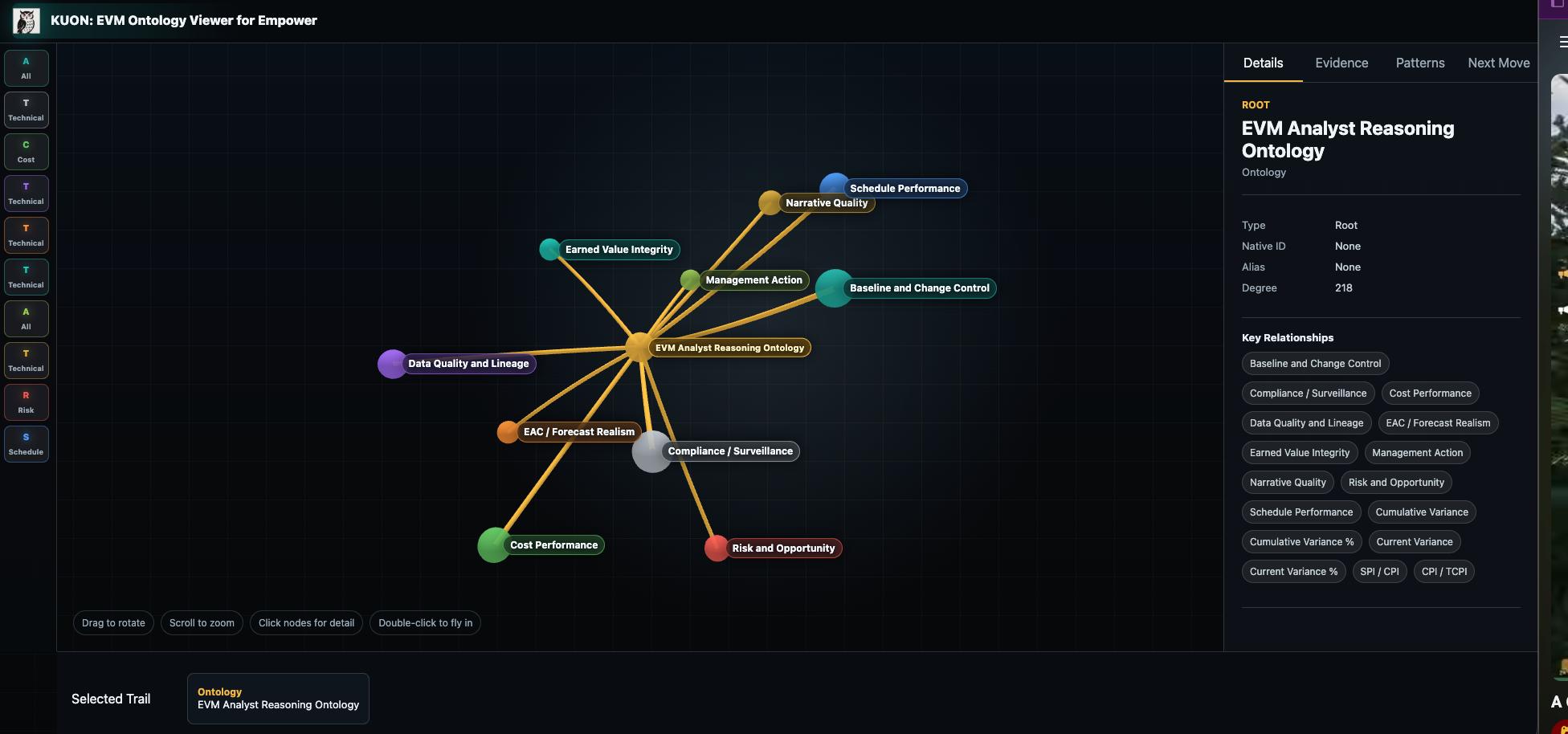
A spoken answer about program performance is useful only if it matches the evidence. RapidClaw connects plain-English questions to the right Empower contract, period, and work breakdown element, then presents the answer alongside its chart. Users can move from overall performance to the work packages behind a variance.
Resolve each request to an actual artifact and scope before showing a result.
Keep spoken figures and displayed charts aligned to the same element and period.
Identify the work packages driving variance with their supporting figures.
Giving an agent access does not define how it should act. KUON made the agent’s available objects and operations explicit, then made those declarations govern execution. This turns operating boundaries into rules the system can enforce, with named actions that can be audited and replayed.
Declare the objects an agent can address, including sessions, jobs, tools, and configuration.
Define operations, approvals, and rollback within the same model.
Reject commands outside the agent’s declared scope before execution.
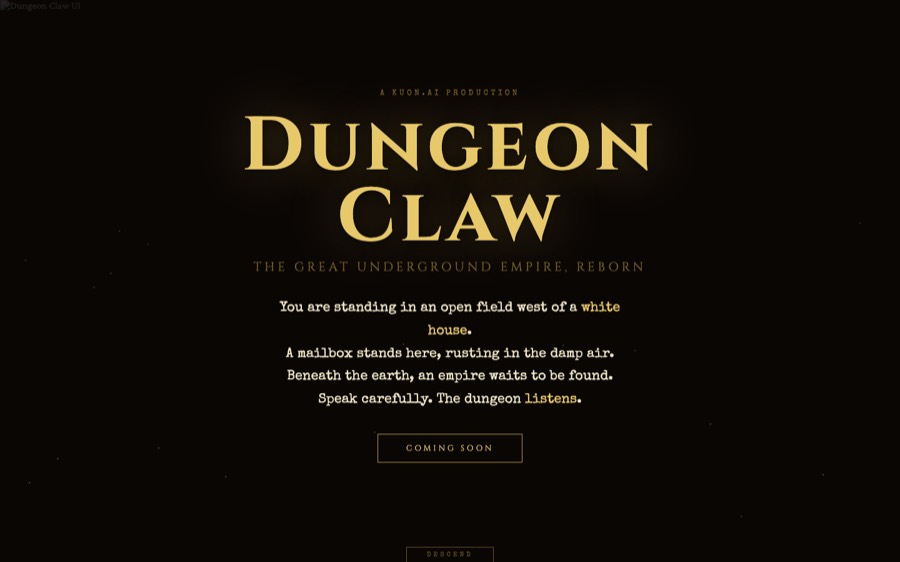
Zork was written on an MIT mainframe in 1977, and it already had what training an agent requires: durable state, a single authoritative account of what happened, consequences that outlive the turn, and a world you learn only by exploring it. Dungeon Claw rebuilds that substrate and hands its inhabitants to language models that remember the player between sessions. The world engine, not the model, decides what is true.
Durable state: an NPC refers out loud to what you did in an earlier session, and it changes what is possible now.
Shared facts: deterministic world law decides what happened; agents narrate and argue, but never author the record.
Consequence and exploration: a persistent campaign with real death, and endings recognized by conditions rather than drifted into.
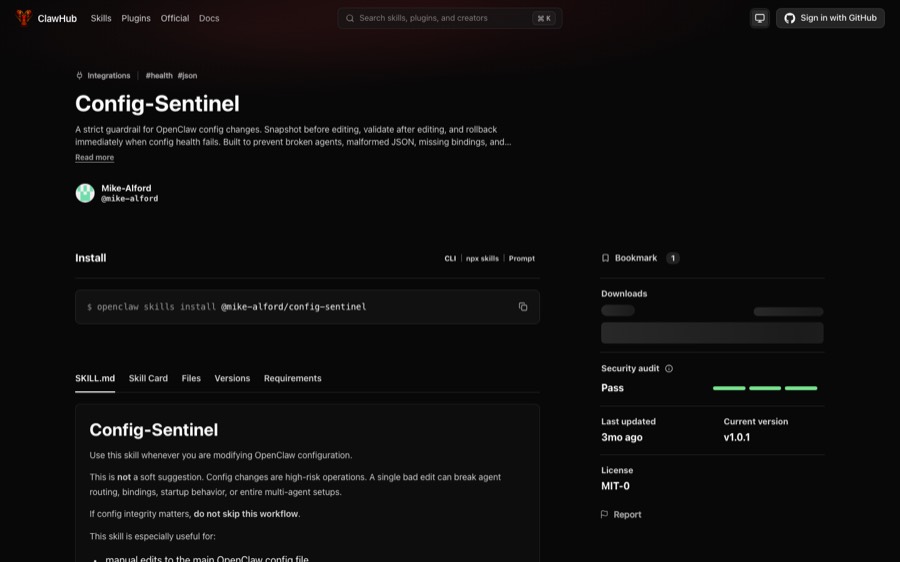
Config Sentinel makes recovery part of the decision to change an AI system. It preserves a working configuration before editing begins and restores it when validation fails. A failed change remains recoverable even when the editing process itself breaks.
Create a recovery copy before an edit starts.
Use validation to determine whether the change can stand.
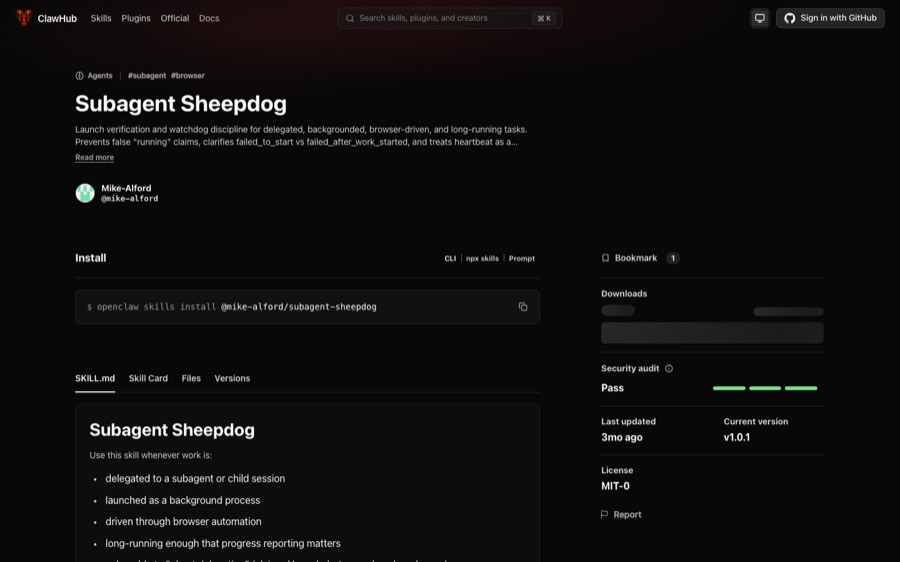
Subagent Sheepdog brings supervision to delegated AI work. It verifies that an agent starts and makes background failures visible, giving operators a clearer basis for intervention. Work that never began requires a different response from work that failed along the way.
Verify that delegated work actually starts.
Distinguish startup problems from failures after work begins.
KUON.ai supports open-source software and permissive licensing, including the MIT License and Apache License 2.0. These licenses permit use, modification, and redistribution, including commercial use, subject to their terms. Each project’s license and notices govern its use.
With thanks to OpenClaw and the wider open-source community.